
School Home Partnership
Find out how the school and parents can work together to raise happy, confident and kind children, guided by the UPS School-Home Partnership Guidelines.
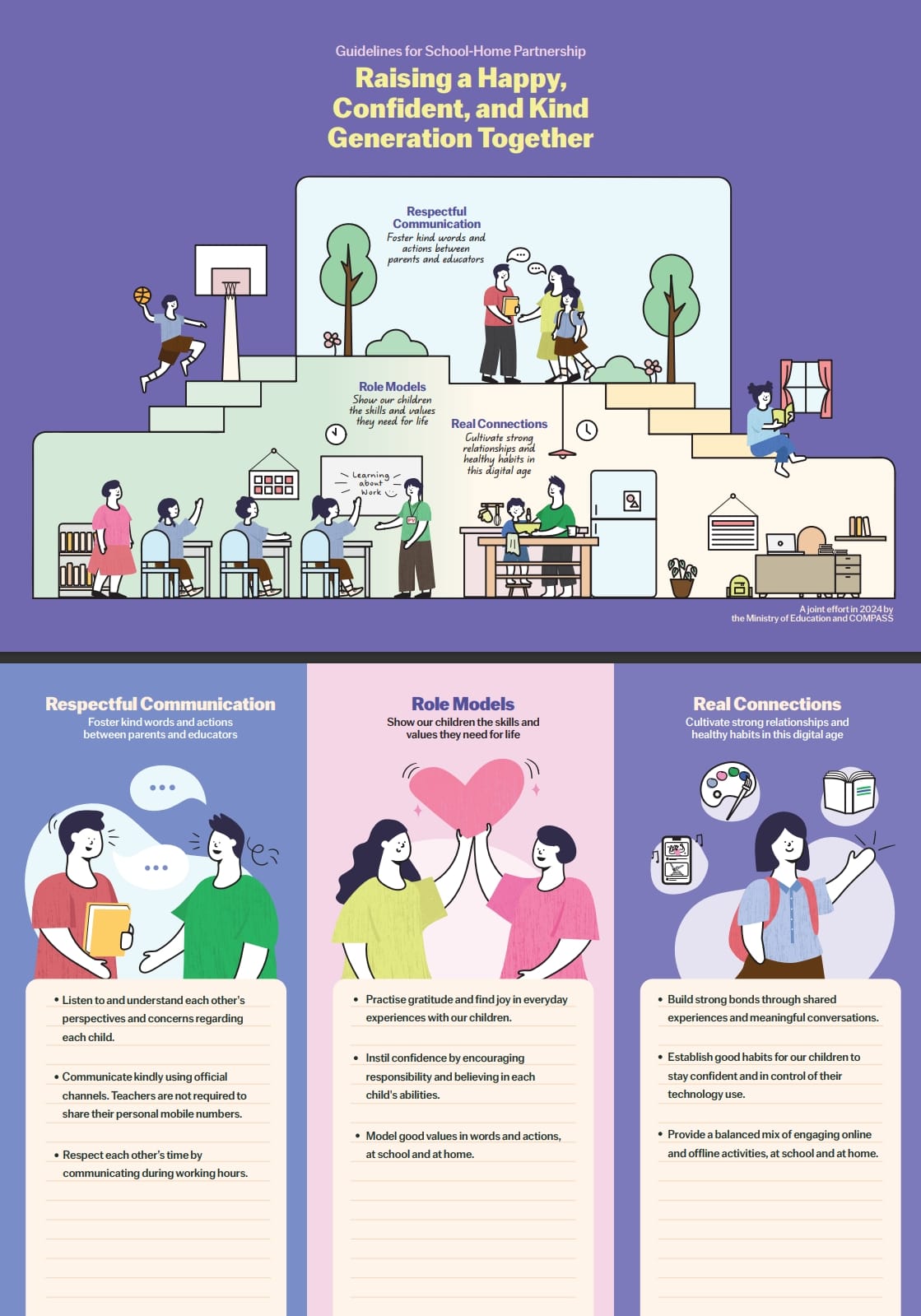
The Ministry of Education (MOE) has refreshed the Guidelines for School-Home Partnership to support parents and teachers with the goal to raise a happy, confident and kind generation together. With the emphasis on strengthening school-home partnerships, the school has contextualised MOE's guidelines into a set of UPS School-Home Partnership Guidelines.
Unity Primary School
School Home Partnership Guidelines (SHPG)
Raising a Happy, Confident & Kind Generation Together
With MOE’s emphasis on strengthening school-home partnerships, the school has contextualised MOE's guidelines into a set of UPS School-Home Partnership Guidelines (SHPG) with inputs from both teachers & parents.
MOE's guidelines into a set of UPS School-Home Partnership Guidelines (SHPG)
Respectful Communication Foster kind words & actions between parents & educators | Role Models Show our children the skills & values they need for life | Real Connections Cultivate strong relationships & healthy habits in this digital age |
1. Set clear communication expectations a. Use official school platforms, e.g. Parent Gateway (PG), school website as primary information sources. b. Use designated platforms, e.g. Class Dojo, MOE email, Student Handbook for communication. c. Teachers will acknowledge queries received within 1 working day. Depending on the complexity of the issue, may take up to 3 weeks. If the school need more time, teacher will give an interim reply. d. For urgent matters, parents to contact General Office. Message will be relayed to relevant staff within the same day except for school holidays. 2. Foster mutual respect & understanding a. Approach conversations with kindness & empathy. b. Address concerns respectfully, seeking clarification when needed. c. Use clear & concise language to communicate. Keep messages focused on child's learning & well-being. d. Acknowledge receipt of important school communications. 3. Parental responsibilities a. Keep an eye on your child during their non-school activities. b. Proactively check official channels, e.g. PG messages for information & updates before contacting teachers. c. Work with school to allow your child the space to learn responsibility, e.g., bringing of items, etc. 4. Teacher responsibilities a. Maintain a respectful tone in all communications. b. Clearly define objectives for parent-teacher conferences or calls. | 1. Foster independence & responsibility a. Guide children to manage their own tasks such as packing school bags & completing homework. b. Establish consistent routines that promote time management skills. c. Allow children to experience natural consequences of minor setbacks, e.g., being reprimanded by teacher for not completing homework on time. 2. Reinforce values & life skills a. Seize teachable moments to model problem-solving strategies when facing challenges. b. Demonstrate resilience by discussing how to cope with & learn from disappointments. 3. Develop emotional intelligence a. Create safe spaces for children to express their feelings. b. Practise active listening to model empathetic communication. 4. Support holistic growth a. Balance the pursuit of excellence with overall well-being. b. Encourage reflection on experiences to develop self-awareness & critical thinking. | 1. Reinforce positive habits a. Celebrate efforts & positive behaviours through small acts of affirmation. b. Cultivate a growth mindset by praising effort & perseverance. 2. Foster meaningful communication a. Engage in open dialogue bearing in mind child’s needs, expectations & well-being. b. Discuss values & attitudes beyond academic results. c. Stay attuned to youth culture to better understand child's perspectives. d. Share personal experiences to build connections. 3. Promote digital well-being a. Share strategies for effective device management & productive screen time. b. Engage in cyber wellness education for safe & responsible online habits. c. Explore educational websites as alternatives to gaming. 4. Balance online & offline experiences a. Leverage home activities that extend learning for family bonding, e.g., discuss their learning experiences at school. b. Encourage outdoor exploration. c. Avail a mix of engaging offline educational resources & activities, e.g. storytelling, playing badminton together, cycling at park connectors to explore nature, playing board or card games, etc. |
Real Connections (opens in new tab)